
Auria Zhang

Enabling effective at-home rehabilitation through real-time tracking and remote clinician monitoring.
X-Heal is a connected rehabilitation platform designed for patients recovering at home. It combines sensor-based motion tracking, real-time feedback, and a clinician dashboard to make remote therapy more effective.
My Role
Lead UX Designer & Full-Stack Developer
— led end-to-end product design and development.
Highlights
-
UX Research & Interface Design
-
React + Firebase Platform Development
-
5G Sensor Integration
-
Sponsored by T-Mobile × UW

The Challenge
After ACL surgery, patients often find it difficult to perform exercises correctly without real-time guidance. Clinicians can only check progress during infrequent visits, making it hard to assess recovery quality or form. Over time, this lack of feedback leads to frustration, loss of motivation, and slower recovery.
“How might we help patients recover confidently at home, while giving clinicians real-time visibility into their progress?”

Goal
Make ACL recovery measurable, motivating, and connected.
Design Process
To address these challenges, we followed an iterative design process that bridged user empathy, data-driven design, and system prototyping.

Research & Insights
We started by investigating how ACL patients perform rehabilitation exercises at home and how clinicians evaluate their progress. Our goal was to uncover barriers in motivation, accuracy, and communication that impact recovery outcomes.
Research Methods
To capture both human experience and clinical context, we combined primary and secondary research.

Problem Landscape
Through this research, we discovered that ACL recovery challenges go beyond movement itself; they reflect a broken feedback loop between patients and clinicians. Rehabilitation begins in the clinic but continues in isolation at home. Without real-time feedback, patients struggle to stay confident while clinicians lack visibility into progress, leaving both sides uncertain about recovery outcomes.
Key Findings
Our research revealed two sides of the same problem: patients lack guidance and motivation, while clinicians lack visibility and data accuracy.
Patients

-
Struggle to perform exercises correctly without guidance
-
Lose motivation when progress feels invisible
-
Can’t distinguish between pain and improvement
Clinicians

-
Rely on in-person visits and subjective reports
-
Lack real-time visibility into home exercises
-
Need faster, reliable digital reports
Together, these insights revealed a broken feedback loop — what patients do isn’t visible, what clinicians know isn’t current, leaving both sides uncertain about true progress.
These insights shaped how we defined our design goals —
bridging human needs, clinical constraints, and technical feasibility.

HOW MIGHT WE help ACL patients recover confidently at home, while giving clinicians real-time visibility into their progress?
Define
This guiding question shaped our design direction — identifying opportunities to build a connected, measurable, and motivating rehabilitation experience.
Design Goal
We defined four experience pillars to guide both system architecture and user experience — connecting motivation, feedback, and clinical reliability.

Clinical Reference — Standard ACL Rehab Movements
To ensure our sensing logic aligned with clinical practice, we analyzed standard ACL rehabilitation protocols from hospital physiotherapy guidelines. These movements informed sensor placement, angle thresholds, and distance-based detection logic used in our system.

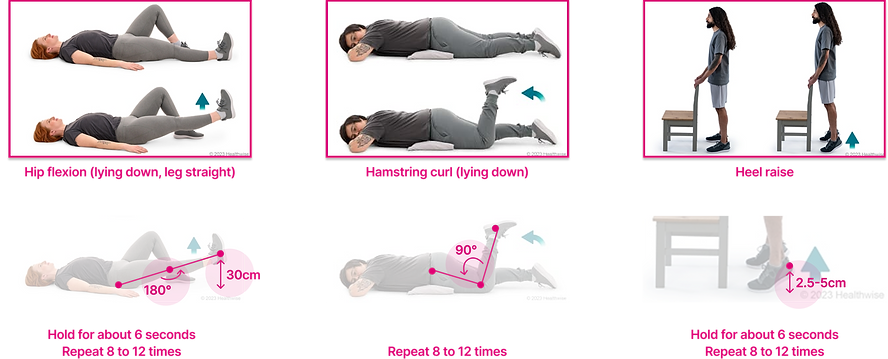
With clinically grounded goals defined, we ideated the connected X-Heal system — bridging human motivation, clinical oversight, and technical feasibility through an integrated architecture.
Ideate
System Ideation — Closing the Feedback Loop
To translate our design goals into a connected solution, we mapped how clinicians, patients, and data interact across the rehabilitation process. The X-Heal system integrates BLE sensors, cloud processing, and real-time dashboards to form a continuous feedback cycle between users and technology.

Each interaction is supported by measurable data — ensuring patients receive timely feedback, and clinicians gain live visibility for adaptive decision-making.
System Highlights

Data Flow
To enable accurate, responsive feedback, we established a data pipeline that processes dual BLE sensor input into actionable rehabilitation insights.

This pipeline transformed raw sensor signals into meaningful recovery feedback — closing the loop between movement, motivation, and clinical oversight.
Prototype
We engineered a two-device system: Knee Device (angle detection) and Ankle Device (height detection) to capture ACL rehabilitation exercises with clinical accuracy.
Sensor & Hardware Layer
The X-Heal prototype uses two synchronized BLE-enabled sensor modules:
-
Knee Device (SEN0221 IMU) — captures leg angle and motion stability during exercises.
-
Ankle Device (VL53L0X TOF) — measures vertical distance from the base to validate leg elevation.
Both are powered by ESP32 microcontrollers, transmitting real-time data via BLE to a React.js interface for live feedback.


System Integration
Each device captures motion data and streams it through X-Heal’s BLE–Firebase architecture.
Together, the system synchronizes both streams into real-time feedback, long-term data storage, and clinician-accessible reports.
Key processes:
Dual-device synchronization and BLE connection handling
Real-time motion data calibration and thresholding
Firebase data logging and clinician dashboard updates
PDF report generation for each exercise session
Knee Device Data Flow

Ankle Device Data Flow

Physical Prototype
Knee Device
Designed for secure alignment along the thigh with adjustable straps for stability.
The enclosure was refined through multiple iterations to improve comfort, reduce slippage, and maintain consistent motion tracking.

Ankle Device
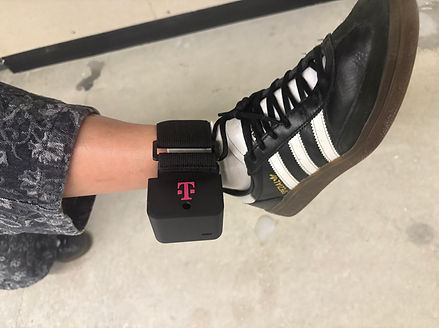
Positioned near the foot to detect leg elevation with steady reference.
The housing was optimized for compactness, easy placement, and unobstructed sensing, ensuring reliable feedback during each exercise.

Final Integrated Prototype


Final Wearable Setup


Interface Prototype
Patient Portal
Overview
The home dashboard summarizes rehabilitation progress, exercise completion, and daily tasks —
helping patients stay on track with their recovery plan.

Home dashboard with progress overview, daily checklist, and session tracking.
Exercise Session
During each exercise, patients follow a demonstration video and receive real-time feedback.
Motion sensors detect leg height and angle, triggering cues such as “Target reached”, “Hold steady”, and a live countdown timer.
When a session completes, the system confirms “Hold done” and logs repetitions automatically.

Real-time feedback interface with video guidance and live motion tracking.
Rehab Records
All completed sessions are stored with duration, evaluation, and downloadable reports — giving patients a clear record of progress over time.

Comprehensive exercise record library with auto-generated PDF reports.
Profile & Schedule
The profile section integrates medical information, flexion progress, and appointment scheduling, connecting physical therapy data with clinical context.

Profile and schedule management supporting consistent rehabilitation.
Clinicians Portal
Dashboard Overview
Provides an instant overview of upcoming appointments, follow-up needs, and patient activity.
Doctors can see prioritized patients and start sessions directly from the dashboard.
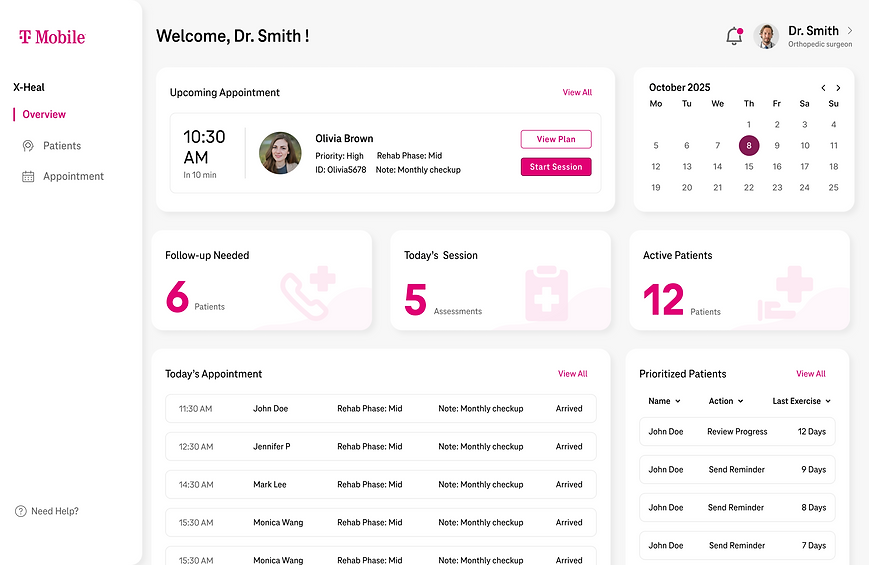
Centralized dashboard with appointment summary and patient priorities.
Patient List
Displays all assigned patients, including their priority level, rehab phase, and most recent activity.
Clinicians can quickly access detailed reports or edit rehabilitation plans.

Patient overview table with progress and management controls.
Rehab Parameters
Enables clinicians to customize recovery plans for each patient — defining target angles, hold times, and training frequency through a unified interface.
Because every patient’s leg length and mobility phase differ, the system automatically adapts motion targets to individual data.
For instance, a “30° lift” corresponds to different physical heights depending on leg length — so the algorithm personalizes the target using the formula leg length × sin(target angle).
Clinicians can also adjust the target angle progressively across recovery phases (e.g., 20° → 25° → 30°) to match each patient’s healing timeline.
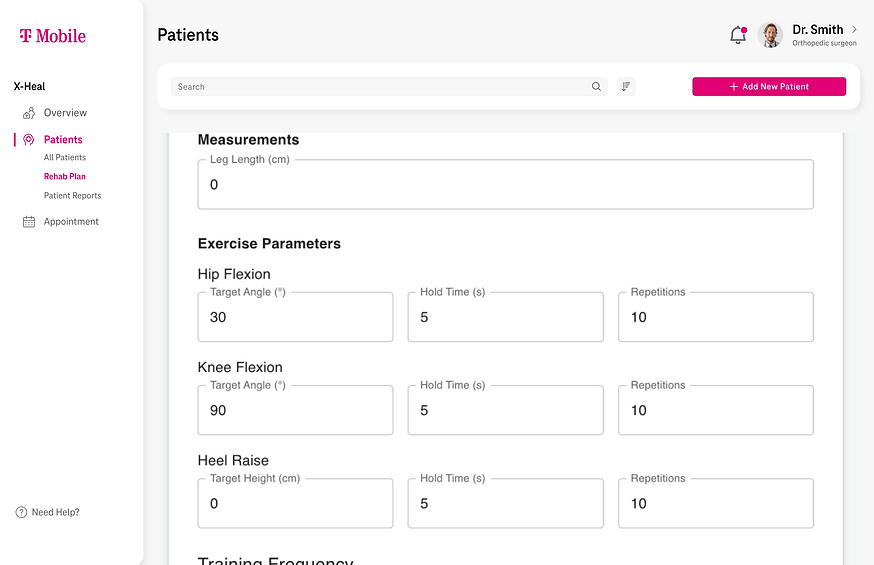
Adaptive parameter setting ensures consistent effort and accurate feedback across users.
The dual-portal system bridges patient recovery and clinical oversight — turning sensor data into actionable progress tracking.
Test & Evaluation
Goal:
Validate the accuracy, usability, and reliability of the dual-sensor system and patient interface in real rehab scenarios.
1. System Accuracy
The dual-sensor setup was tested for consistency in angle and height detection.
Results showed < ±3° deviation in angle and < ±1 cm in height from clinical measurements.

Calibration log verifying sensor initialization and stability before BLE synchronization.
2. Cloud Reliability (Firebase Validation)
Data flow from both knee and ankle devices to Firebase was tested to ensure real-time integrity.
Logging success rate reached >99%, with sub-second average write latency and >95% PDF report generation completion.
This validated stable BLE–Firebase synchronization under real-use conditions.

Firestore database view showing real-time data logging during rehabilitation sessions.

Firebase Storage view with automatically generated exercise reports confirming cloud sync and file creation.
3. Usability Pilot
Short rehab sessions were conducted with simulated ACL patients to evaluate guidance and detection accuracy.
Participants followed video demonstrations and real-time cues (“Target reached”, “Hold steady”) successfully, achieving over 90% motion-detection accuracy.

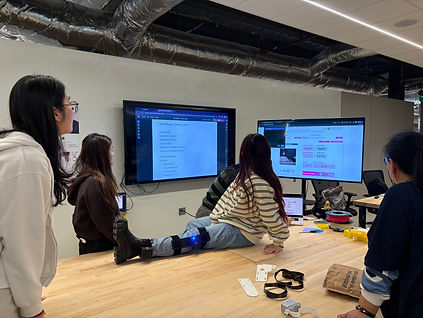
Participants completed guided sessions with high accuracy and engagement.
4. Clinician Feedback
Therapists who reviewed the prototype emphasized the clarity of real-time feedback and the usefulness of automated progress reports for remote supervision.
They noted potential to reduce in-person monitoring time and improve patient adherence tracking.
Impact & Reflection
Industry Impact
The X-Heal system and dual-device concept were adopted by T-Mobile’s Connected Health initiative for continued research and development.
Our prototype demonstrated how IoT connectivity and UX-driven design can close the feedback gap in rehabilitation — turning complex clinical data into intuitive recovery insights.

Project Outcome
The project achieved full integration from hardware and BLE sensing to real-time cloud reporting and interactive patient-clinician dashboards.
Our cross-disciplinary approach proved the feasibility of a connected rehabilitation experience that aligns with clinical practice.

Reflection
Presenting to T-Mobile’s Connected Health innovation team reinforced the importance of translating technical systems into clear, human-centered value.
As both UX lead and full-stack developer, I learned how strategic design decisions — from interface flow to data architecture — define adoption potential, not just usability.